
In late 2019 and early 2020, the cities of Burlingame and Millbrae completed separate efforts to analyze their flooding risk resulting from both sea level rise in San Francisco Bay (Bay) and precipitation from major storms. Within these studies, each developed and screened strategies to protect communities adjacent to the Bay shoreline and the major creeks that flow to it. Meanwhile, over the past several years, San Francisco International Airport (SFO) has developed a Shoreline Protection Program to protect the entire perimeter of the Airport from sea level rise.
Large areas of both cities (and the entirety of SFO) are projected to be inundated during the current FEMA 100-year event plus approximately 6 feet of sea level rise. Many regionally significant assets are located in this floodplain, including electrical distribution facilities, a regional commuter rail corridor and intermodal transportation center, regional water treatment plant, hazardous material sites, many major hotels and other businesses, U.S. Highway 101, and of course, SFO. In addition, other studies completed by San Mateo County explored flooding emanating from areas within Millbrae and SFO property affecting inland areas in the City of San Bruno (particularly, the Belle Air neighborhood) that were recently mapped into the FEMA 100-year floodplain. This project’s regional approach also allows for protection to these disadvantaged inland areas.
The District is partnering with the City of Burlingame, City of Millbrae, and SFO Airport to align, connect, and advance their efforts in a coordinated way, rather than each jurisdiction continuing to spend time and money on independent studies that cannot fully address this monumental regional challenge. Last fall, these project partners, with the City of Burlingame serving as the grant applicant, applied for federal funding under the new FEMA Building Resilient Infrastructure and Communities (BRIC) grant program to support the early steps in the project, including data collection, community outreach, and an alternatives analysis.
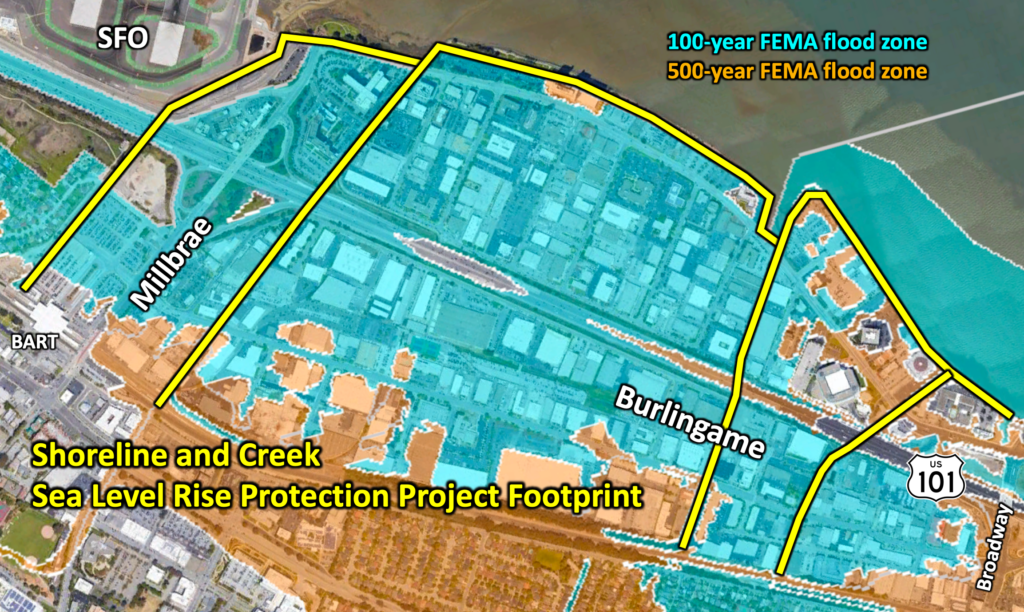
In the long-term, the project objective is to raise shoreline and creek bank elevations along 1.6 miles of Bay shoreline and 1.5 miles of creeks (shown in yellow on the figure below) to remove properties from the current FEMA 100-year floodplain plus approximately 6 feet of sea level rise – a Bay water level approximately 10 feet above today’s daily high tide.
In line with the District’s core principles, the project team will take a holistic approach to objectives by seeking to incorporate environmental, recreational connectivity, and community-building considerations into its evaluation of alternatives.